

How to Repent According to the Bible: A Step-by-Step Spiritual Guide
Ever felt that knot in your chest after a mistake, wondering if anyone—or even God—could truly forgive you?
You're not alone. We all stumble, and the Bible doesn't just brush the topic aside; it offers a clear roadmap for genuine repentance.
So, what does "how to repent according to the Bible" actually look like in everyday life? Think of repentance as a three‑part conversation with the Creator: acknowledging the wrong, turning away, and seeking restoration.
First, the confession. Psalm 32 tells us, “I acknowledged my sin to you… and you forgave my iniquity.” That moment of honest admission—no excuses, no blame‑shifting—breaks the power the sin holds.
Next comes turning. In Acts 3:19 the apostle urges, “Repent, then, and turn to God, so that your sins may be wiped out.” It’s not just feeling sorry; it’s a deliberate shift of heart and behavior. For many of our readers, that means swapping a habit of gossip for a habit of prayer, or replacing late‑night scrolling with a quiet time of scripture.
Finally, restoration. 2 Chronicles 7:14 promises that when we humble ourselves, pray, and seek God’s face, He will heal our land. Practically, that can look like making amends with the person you hurt, or serving in a way that reflects the love you’ve received.
In our experience, pairing these steps with a focused study—like the e‑book "All Sins Will Be Forgiven"—helps keep the process concrete. The guide breaks down each stage, offers journal prompts, and reminds you that grace covers every sin except the one that rejects forgiveness itself.
Does this feel overwhelming? Not at all. Start small: write down the specific thing you need to own up to, pray for the courage to change, and take one actionable step today.
Ready to walk this path? Let’s dive deeper into each biblical principle and see how you can experience true freedom.
TL;DR
The Bible shows repentance as honest confession, a heartfelt turn away from sin, and active restoration, guiding you toward God’s forgiveness and lasting peace.
Start today by writing your confession, praying for change, and taking one step toward making amends, using the All Sins Will Be Forgiven e‑book for accountability.
Step 1: Acknowledge Your Sin
Imagine the weight of that knot in your chest finally coming to light. It’s that uncomfortable moment when you realize you can’t keep sweeping the mistake under the rug any longer. You’re not just feeling guilty—you’re staring at a truth that needs naming.
First thing’s first: name the sin. Psalm 32 gives us a perfect model—"I acknowledged my sin to you…"—so grab a notebook and write down exactly what you did, why it mattered, and how it hurt you or others. No sugar‑coating, no vague "I was wrong." Be specific, like "I gossiped about Sarah’s health and spread anxiety in our group". The act of naming strips the sin of its shadowy power.
Why honesty matters
When we’re honest with God, He meets us in our brokenness. It’s not about a legalistic confession; it’s about opening a door for grace. Think about it this way: a cracked window lets in fresh air, but you have to admit the window’s broken before you can fix it. If you keep pretending the glass is whole, the draft never stops.
In our experience, many people stumble right at this step because they fear judgment. That’s where a tool like the All Sins Will Be Forgiven e‑book can help. It offers guided journal prompts that walk you through the confession process, turning abstract remorse into concrete words.
So, how do you actually do it? Here’s a quick, three‑point checklist:
- Pick a quiet spot—maybe after your morning coffee or before bedtime.
- Write the sin in plain language, as if you’re telling a trusted friend.
- End with a single sentence that admits responsibility: "I am sorry for..."
Does this feel awkward? Absolutely. That’s the point. The discomfort signals that you’re moving past denial into genuine acknowledgment.
Once you’ve written it down, say it aloud. Hearing your own voice say the words can be surprisingly powerful. It’s like looking at yourself in a mirror you’ve avoided for years.
Now, let’s bring a little extra perspective. Rev Dr Boudreau, a fellow faith‑focused author, writes about the transformative power of honest confession in his work on redemption. His insights echo the biblical call to own our mistakes, and they can deepen your understanding of why this step matters (source: Rev Dr Boudreau).
After you’ve confessed, create a small ritual to mark the moment—light a candle, play a soft hymn, or simply pause in prayer. This physical anchor helps your heart remember the confession long after the words are written.
Notice how the video above walks through Psalm 32’s confession example. It’s a good visual reminder that the Bible doesn’t just tell us to confess—it shows us how.
Feeling stuck? Sometimes the environment can hinder honesty. That’s where a touch of visual inspiration can shift the atmosphere. Gratitude Studios creates beautiful landscape art that can turn a plain wall into a space of reflection (see Gratitude Studios). Placing a calming piece nearby can remind you that grace is always present, even in the midst of admission.
Finally, give yourself a moment of grace after the confession. You’ve just taken a bold step toward healing; don’t immediately launch into a self‑critique. Instead, thank God for the courage to be honest, and breathe.

When you return to your day, keep the confession fresh in your mind. Re‑read what you wrote, let it shape your choices, and watch how the knot in your chest gradually loosens. That’s the first, essential stride in learning how to repent according to the bible.
Step 2: Confess to God
Alright, you’ve named the sin. Now comes the part that feels most vulnerable: actually saying it to God. It’s not about crafting a perfect speech; it’s about opening your heart like you would to a trusted friend who’s been waiting for you to show up.
First, find a place where you can be alone—maybe that quiet corner you set up in Step 1, or a spot in nature where the wind seems to hush the noise. Turn off distractions. Take a deep breath, and let the weight of the day settle. You’re about to lay something raw on the altar of grace.
Speak the Words, Not the Whispers
When you pray, use concrete language. Instead of “I’m sorry for my mistakes,” try, “Lord, I confessed to gossiping about Sarah on Monday, and I hurt her trust.” Naming the act strips it of the fog that keeps it hidden.
David’s own confession in Psalm 51 shows us the pattern: acknowledge the sin, describe its impact, and ask for cleansing. If you need a model, check out this prayer of repentance guide that walks you through those exact phrases.
Feel the tension rise? That’s the conviction God is stirring—good news, it means your heart is moving. You might even notice a lump in your throat; don’t fight it. Let the words flow, even if they sound clumsy.
Make It a Dialogue
After you’ve spoken, stay silent for a moment. God’s response isn’t always an audible voice; it can be a peace that settles over you, a scripture that pops up on your phone, or a sudden calm in your chest.
Ask a follow‑up question: “What do I need to do next, Lord?” That opens the door for Him to guide your next steps, whether it’s a phone call, a written apology, or a small act of service.
So, what should you do right after the confession?
Immediate Action Checklist
- Write down the confession verbatim in your journal.
- Mark a specific, doable next step on your calendar (e.g., call Sarah on Thursday).
- Pray for courage and for God’s grace to follow through.
Doing this turns a fleeting feeling into a concrete plan. It’s the bridge between saying “I’m sorry” and actually living it out.
Here’s a quick visual to keep you on track:
Notice how the video walks through a simple confession prayer. Play it while you’re kneeling, and let the words guide your own. It’s okay to pause, repeat, or even write the lines down before speaking.
Remember, confession isn’t a one‑off event. Each day, ask yourself, “What am I still hiding?” and repeat the process. Over time, those hidden knots start to loosen, and you’ll feel the freedom that comes from being truly seen by God.
In our experience helping people seeking spiritual growth, the combination of a spoken confession, a written record, and a concrete next step creates momentum that many find hard to lose. It’s the practical side of grace at work.
Take a moment now: close your eyes, whisper your confession, and write down the first step you’ll take this week. You’ve got this, and God’s waiting with open arms.
Step 3: Seek Genuine Repentance
Now that you’ve owned up to the sin and whispered it to God, the real work begins: genuine repentance. It’s more than “I’m sorry.” It’s a heart‑shift that moves you from regret to restoration.
Do you ever notice that after a bad day you feel a knot in your chest, but the next morning it’s gone? That fleeting remorse is useful, but it doesn’t change anything. Genuine repentance is the “godly sorrow” Paul talks about—pain that propels you into new habits (see what the Bible says about repentance).
Step 3‑1: Identify the Godly Sorrow
First, pause and ask yourself, “Am I feeling sorry for the consequence, or sorry because I’ve hurt God?” If the former, you’re probably just experiencing remorse, like Judas felt (see the distinction in Renner’s article on remorse vs. repentance). Godly sorrow makes you want to fix what’s broken, not just wipe away the tears.
Take a breath, close your eyes, and picture the person you’ve hurt. What would it look like if you kept walking away? That mental image often brings the needed conviction.
Step 3‑2: Declare a Concrete Turn‑Away
Next, write a short “turn‑away statement.” Something like, “I will stop gossiping about Sarah and instead pray for her.” The key is specificity. Vague promises like “I’ll be better” evaporate quickly.
Set a tiny, time‑bound action. Maybe it’s a phone call tonight, or a note you’ll send tomorrow. Mark it on your calendar—just like you did in Step 2. When the date arrives, treat it like a non‑negotiable appointment with grace.
Step 3‑3: Make Restitution When Possible
If your sin hurt someone, look for a way to make it right. Restitution can be a sincere apology, returning something you took, or offering a service that helps the other person heal. It doesn’t have to be grand; even a handwritten note can carry weight.
When you’re not sure what restitution looks like, ask God in prayer: “Lord, how can I restore what I’ve broken?” Often the answer comes as a gentle nudge—a reminder to listen, to serve, or simply to be present.
Step 3‑4: Keep a Repentance Check‑In
- Every evening, ask: “Did I honor my turn‑away promise today?”
- Jot a quick note in a journal (or use a digital note).
- If you missed the mark, repeat the confession, then adjust the action plan.
This habit turns repentance from a one‑time event into a lifestyle. In our experience working with people seeking spiritual growth, those who keep a daily “repentance log” report deeper peace and fewer relapses.
Remember, genuine repentance isn’t about perfection; it’s about perseverance. When you stumble, you don’t throw in the towel—you get up, confess the slip, and re‑commit.
So, what’s the next concrete step you can take right now? Grab a pen, write that turn‑away statement, and set a reminder for tomorrow. You’ve already taken two steps; this third one will bridge the gap between confession and true transformation.
God’s promise is clear: when we turn away with a contrite heart, He is faithful to restore us (2 Chronicles 7:14). Let that promise fuel your daily walk.
Take a moment now: breathe, write, and commit. Each small step rewires your heart, and you’ll see God’s grace shaping a new you.
Step 4: Turn Away and Pursue Righteousness
Okay, you’ve already owned the sin, spoken it out, and felt that God‑sourced sorrow. Now it’s time for the part that feels a little… messy, because you have to break a habit and start a new one.
Turning away isn’t just “stop doing X.” It’s an active decision to replace the old pattern with something God‑pleasing. Think of it like swapping a stale coffee for fresh brew—you’re still drinking, but the flavor’s completely different.
What does “pursuing righteousness” look like day‑to‑day?
First, name the exact behavior you’re quitting. Instead of “I’ll quit gossip,” write, “I’ll stop repeating any story about Sarah that isn’t spoken to me directly by her.” Specificity is the bridge between intention and action.
Second, pair that negative with a positive habit. If you’re cutting gossip, decide to pray for the person you’d normally talk about, right after you hear the temptation. The prayer becomes the new default response.
Does that sound doable? It does when you break it into micro‑steps. Here’s a quick three‑step loop you can try right now.
The “Turn‑Away Loop”
1. Spot the trigger. Notice the moment you’re about to fall back—maybe a text, a coffee break, a stressful meeting.
2. Interrupt. Take a breath, count to three, and say a short Scripture out loud (e.g., “Let my mouth speak what is good” – Psalm 34:13).
3. Redirect. Move to the positive action you wrote down—call, pray, write an encouraging note, or simply walk away for a minute.
Do you see how the loop turns a guilt‑trip into a grace‑trip? It’s the same principle David wrestled with in Psalm 51, where he not only confessed but asked God to “cleanse” him and “renew a steadfast spirit” (The Gospel Coalition).
Check‑in checklist (evening)
- Did I notice every trigger?
- Did I pause and speak Scripture?
- Did I follow through with the replacement habit?
- If I missed a step, what’s the one tweak for tomorrow?
Writing those answers in a journal (or a notes app) creates a “repentance log” that many of our readers say keeps them honest. The log isn’t a scorecard; it’s a conversation with yourself and God about where grace is working and where you still need a nudge.
And remember, righteousness isn’t perfection. It’s persistence. When you slip, you don’t declare defeat—you repeat the confession, adjust the plan, and keep moving forward. That perseverance is exactly what the Bible calls “a broken spirit… yet a steadfast heart.”
Here’s a handy comparison of the three core elements we’ve covered so far. Use it as a quick reference before you close your day.
| Stage | Key Action | Practical Tip |
|---|---|---|
| Acknowledge | Write the sin in concrete terms | Use “I did X to Y” format |
| Confess | Speak it aloud to God | Pair with a short Scripture |
| Turn Away | Replace with a positive habit | Use the Turn‑Away Loop each trigger |
Want a deeper dive on how Psalm 51 structures these steps? The Gospel Coalition breaks it down nicely, showing how David’s prayer moves from confession to a renewed spirit.
Finally, give yourself a small celebration today—maybe a cup of tea after you’ve logged the day’s wins. That tiny reward tells your brain “I’m doing something worth keeping,” and it makes the next turn‑away easier.
So, what’s the first habit you’ll replace tonight? Grab that notebook, write the trigger, and set a reminder for tomorrow morning. You’ve already taken three steps; this fourth one is the one that turns promise into practice.
Step 5: Maintain a Repentant Heart
You've walked the first four steps—acknowledge, confess, turn away, and replace the habit. Now the real test begins: keeping that fresh, repentant heart beating day after day.
Why does it feel so tough? Because repentance isn’t a one‑time event; it’s a lifestyle. Think of it like training a muscle. You lift weights once, and you’re sore but stronger. You keep lifting, and the muscle grows. The same goes for a contrite spirit.
So, how do we make that muscle work consistently? Let’s break it down into three practical habits you can start tonight.
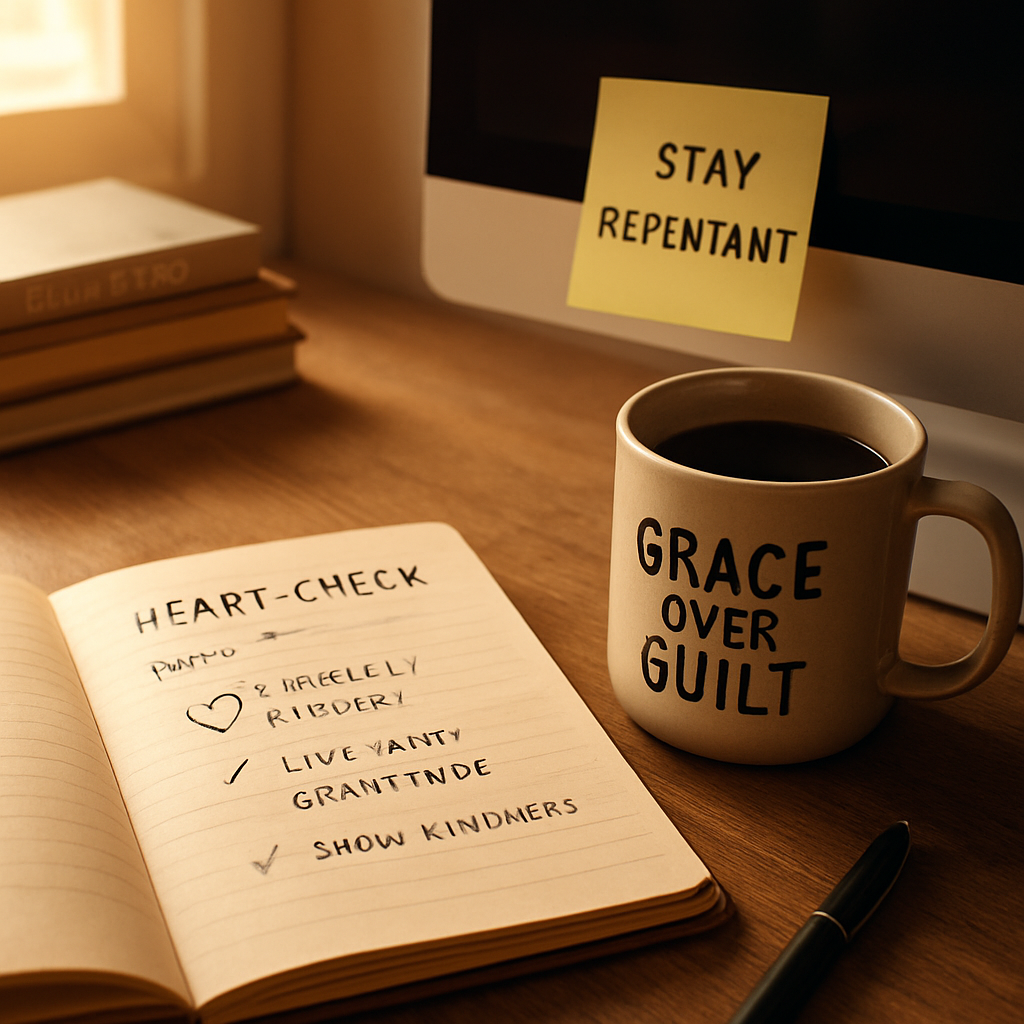
1. Daily “Heart‑Check” Pulse
Every morning, set aside two minutes to ask yourself, “What’s lingering in my heart right now?” Write a quick note—no essay, just a line or two. If you notice a trace of the old sin, name it. For example, “I felt the urge to gossip about Sarah during lunch.” Naming it turns a vague feeling into a concrete target.
Then, counter‑point it with a Scripture that speaks to the opposite behavior. Psalm 51:10 says, “Create in me a clean heart, O God.” Whisper that phrase, let it settle, and move on. Over a week you’ll see patterns emerge, and you’ll start catching yourself before the sin re‑attaches.
2. The “Grace Reminder” Anchor
Pick an object you see many times—a coffee mug, a wristband, a sticky note on the fridge. Write a short reminder on it, like “Grace over guilt” or “Heart‑check moment.” Each time your eyes land on that object, pause, breathe, and ask, “Am I walking in repentance today?”
This tiny visual cue does more than jog your memory; it rewires your brain to associate the everyday with spiritual vigilance. It’s the same trick athletes use with a wristband to signal focus.
3. Weekly “Restoration Review”
At the end of each week, grab your journal and flip to the page where you recorded your daily heart‑checks. Highlight any recurring themes and ask, “What concrete step can I take next week to break this cycle?” Maybe it’s scheduling a brief call to apologize, or setting a reminder to pray for someone you keep judging.
Write a short action plan—one specific thing, not a vague goal. Then, pray for the strength to follow through. When you see the plan laid out, it feels less like a wish and more like a commitment.
Does this sound like a lot? It can be, but remember: repentance isn’t about perfection; it’s about persistence. If you miss a day, don’t write yourself off. Just note the slip, adjust the plan, and keep moving forward.
And here’s a little secret most people miss: the heart stays repentant when it’s fed with gratitude. After you’ve logged a day’s wins—whether it’s a successful apology or simply choosing prayer over gossip—take a moment to thank God for that tiny victory. That gratitude fuels the next step, creating a positive feedback loop.
For those of us who love a good resource, the “All Sins Will Be Forgiven” e‑book offers extra journal prompts that line up perfectly with these habits. It’s a handy companion, especially when you hit a plateau and need fresh insight.
So, what’s the next tiny habit you’ll add to your routine? Maybe it’s placing that sticky note on your laptop lid tonight. Maybe it’s setting a phone alarm titled “Heart‑Check” for 7 am tomorrow. Whatever it is, take the step now—your future self will thank you.
Conclusion
We've walked through the whole journey of how to repent according to the bible, from that uneasy confession to the quiet habit that keeps your heart steady.
If you’ve ever felt the knot in your chest after a slip, remember that the same knot can loosen each time you name the sin, pray honestly, and choose a tiny, concrete step forward.
The real power lies in the daily “heart‑check” – a two‑minute pause that asks, “What’s still tugging at me?” Write it down, pair it with a verse, and let gratitude seal the moment.
You don’t have to overhaul your whole life overnight; just one habit – like swapping gossip for a quick prayer, or swapping scrolling for a scripture card – creates a ripple that God can use.
And when a slip happens, treat it as a data point, not a defeat. Adjust, confess again, and move forward – the same cycle we’ve outlined in every step.
So, what’s the next tiny action you’ll take right after this page? Maybe set a sticky note on your laptop, schedule a five‑minute morning prayer, or simply write down today’s confession.
Keep the momentum going, lean on the tools we’ve shared, and trust that God’s grace meets you right where you are.
FAQ
What does the Bible actually teach about how to repent according to the Bible?
In Scripture repentance is a three‑part move: own the sin (Psalm 32), turn away with a new heart (Acts 3:19), and seek restoration (2 Chronicles 7:14). The key is honesty—no excuses, just a plain‑spoken confession—followed by a concrete step that shows the heart is changing. When you pair each step with a verse, the process feels less abstract and more like a conversation with God.
How can I start a simple daily “heart‑check” that keeps me honest?
Set a two‑minute alarm in the morning. When it rings, ask, “What’s still tugging at my heart right now?” Jot a quick line in a notebook or phone note. If a sin shows up, write a short Scripture that opposes it—like “Let my mouth speak what is good” (Psalm 34:13). That tiny pause creates a feedback loop, turning hidden habits into visible choices.
Do I need to tell another person about my sin, or is speaking to God enough?
God hears every whispered confession, so prayer alone is valid. Yet sharing with a trusted friend or counselor can add accountability and prayer support. In James 5:16 we see the power of “confessing… to one another.” If you’re comfortable, choose someone who will listen without judgment and pray with you; it often turns a private sorrow into a shared step forward.
What’s a realistic habit I can swap for a sinful behavior?
Pick the exact trigger—say, scrolling social media when you feel lonely. Replace it with a 30‑second prayer or a gratitude note. Write the replacement on a sticky note where the phone lives. The trick is specificity: “When I open Instagram, I’ll pause, say ‘Lord, thank you for today,’ then close the app.” Small swaps train the brain to choose grace instead of the old pattern.
How should I deal with lingering guilt after I slip again?
First, acknowledge the slip without beating yourself up. Bring the incident back to Scripture—Psalm 51 reminds us that God “does not despise the contrite heart.” Write a brief confession, then identify one concrete action to make restitution or to guard against the same trigger. Treat the slip as data, not defeat, and let the next step reset your momentum.
Can a journal really help me track repentance, and what should I record?
Absolutely. Use three columns: the sin you noticed, the Scripture you paired it with, and the next step you’ll take. Keep entries brief—one sentence per column—but be consistent. Review the log weekly; you’ll spot patterns and see how many “turn‑away” steps you’ve actually completed. That visual proof builds confidence and reminds you that God’s grace is meeting you daily.