

How to Test the Spirits According to the Bible: A Practical Step‑by‑Step Guide
Let me be completely honest: trying to figure out whether a voice, a feeling, or a prophecy is truly from God can feel like walking through a foggy forest at night.
Ever had that moment when a thought seems too good to be true, yet it also feels strangely familiar, like a whisper you think you heard before?
That uneasy tension is exactly why the Bible gives us a practical way to test the spirits, so we don’t waste years chasing shadows.
In our experience helping people seeking spiritual growth, we’ve seen how a simple, Scripture‑based checklist can bring peace of mind and keep you anchored to God’s truth.
So, what does "how to test the spirits according to the bible" actually look like in everyday life? It starts with a few key questions that any believer can ask, no matter how seasoned or new you are.
First, does the message line up with what God has already revealed in His Word? If it contradicts the clear teachings of Scripture, it’s a red flag.
Second, does the spirit produce the fruit of love, joy, peace, patience, kindness, goodness, faithfulness, and self‑control? The Bible says any other fruit is a sign of deception.
And third, does the leading bring you deeper into a relationship with Jesus, or does it pull you away toward self‑reliance or fear?
Think about a time when you felt led to make a big decision. Did you check the Bible, pray, and maybe even reach out for wise counsel? That pause is the very “testing” the apostle John warns us about.
Now imagine having a resource that walks you through each step, with scriptural references and real‑life examples. That’s the kind of guidance we aim to provide in our e‑books, helping you apply the test without getting lost in theory.
Ready to stop guessing and start discerning? Stick with us, and we’ll show you how to put the biblical test into practice so you can walk confidently, knowing you’re following the true Spirit.
TL;DR
Testing spirits biblically means matching every impression against Scripture, checking for godly fruit, and ensuring the leading deepens your personal, daily relationship with Jesus.
Our step‑by‑step checklist guides believers through prayer, counsel, and scriptural cross‑reference, so you can confidently discern truth from deception and walk in spiritual confidence in life.
Step 1: Evaluate Biblical Criteria
First thing’s first: before you start matching a whisper against Scripture, ask yourself what’s really stirring in your heart. Is it excitement, fear, curiosity? That emotional cue is the hook that tells you a spirit is trying to get your attention. Recognizing that feeling is the doorway to the real work of testing.
Now, grab your Bible and a quiet spot—maybe light a candle, sip some tea, or even set up a calming bath (a good time to check out a relaxing shower steamer guide for the perfect ambiance). The first biblical yardstick is simple: does the impression line up with what God has already said?
Step 1A: Cross‑Reference the Text
Take the exact phrase or promise you heard and flip through the relevant passages. If it’s a claim about salvation, compare it with John 3:16, Romans 10:9‑10, and Ephesians 2:8‑9. If the wording conflicts, you’ve got a red flag. It’s like trying to fit a square peg into a round hole—if it doesn’t fit the Scripture, it’s not from the Holy Spirit.
Tip: Write the impression down word‑for‑word, then pull a concordance or use a digital search tool. Seeing the verses side by side makes the mismatch obvious.
Step 1B: Check the Fruit
Even if the message sounds biblical, ask, “What fruit does it produce?” Galatians 5:22‑23 lists love, joy, peace, patience, kindness, goodness, faithfulness, and self‑control. Does the leading nurture those qualities in you, or does it stir anxiety, division, or self‑glorification? If it’s the latter, the spirit is likely deceptive.
And here’s a quick self‑test: after you’ve prayed about the impression, wait 24‑48 hours. Do you notice a growing sense of peace, or does the idea keep nagging you? The fruit test isn’t a one‑minute snapshot; it’s a short‑term climate check.
Step 1C: Seek Wise Counsel
Proverbs 11:14 reminds us that “where there is no counsel, the plans fail.” Share the impression with a trusted mature believer—someone who’s walked this path before. Their perspective can catch nuances you missed. If they echo the biblical alignment and fruit, you’re on solid ground.
In our experience, many of our readers find that a short conversation with a small‑group mentor clears up confusion faster than endless solo study.
When you’ve run the three checks—scripture, fruit, counsel—you’ll have a clearer verdict. If everything lines up, you can move forward with confidence, knowing you’re walking in step with the Spirit.
And because spiritual health isn’t just about the mind, consider the whole person. XLR8well’s proactive health resources can help you maintain the physical stamina needed for consistent prayer and study.
Below is a quick checklist you can print or jot in your journal:
- Write the impression verbatim.
- Locate every Scripture that speaks to the claim.
- Ask: Does it match? Does it contradict?
- Identify the fruit it produces in your life.
- Discuss with a trusted mentor.
- Pray for peace and confirmation.
Ready to see this in action? Our angelic ministry e‑book walks you through real‑world examples of discerning holy versus fallen messages, giving you a practical toolbox for everyday decisions.
Let’s pause for a moment of reflection. Imagine you’re sitting by a window, sunlight streaming in, and you’re hearing that gentle nudge to start a new ministry. You’ve just run the checklist. The Scriptures align, the fruit feels gentle, your mentor nods in agreement, and you feel a deep, abiding peace. That’s the moment the Holy Spirit says, “Yes, go.”
Take a breath. The video just showed how a simple prayer can open the door to divine clarity. Now, put that into practice with the checklist above.
When you finish this step, you’ll have a solid foundation for the next stages—examining the source’s character and measuring the long‑term impact on your walk with Christ. Keep the checklist handy; it’s your compass in the fog.
Step 2: Use the Test of the Spirits (1 John 4:1)
Alright, you’ve already checked the Bible for consistency. Now it’s time to put John’s famous warning into practice: “Do not believe every spirit, but test the spirits.” This isn’t a fancy theological exercise – it’s a hands‑on, everyday habit that keeps you from chasing phantom whispers.
Why the "test" matters
Think about the last time a friend told you a “new revelation” about prosperity. It felt exciting, right? But if you let that idea settle without testing, you could end up chasing a promise that leaves you poorer in peace. The test is the safety net that protects your heart from deception.
Three‑minute “Spirit Scan”
Here’s a quick, repeatable routine you can run whenever a new impression hits you. Grab a notebook, set a timer for three minutes, and work through these questions.
- 1. Does it confess Jesus? 1 John 4:2‑3 says any spirit that does not acknowledge Jesus came in the flesh is false. Write down the core claim and ask, “Is Jesus presented as the Savior, not a moral teacher or a self‑help guru?”
- 2. Does it bear fruit? Look at Galatians 5:22‑23. Does the idea produce love, joy, peace, patience, kindness, goodness, faithfulness, or self‑control in the life of the person sharing it? If the “teaching” seems to stir anxiety, greed, or division, flag it.
- 3. Does it deepen your relationship? After you pray on the impression, does your desire to spend time with God grow, or does it make you want to rely on your own wisdom? A true spirit nudges you toward deeper prayer, not self‑reliance.
Mark each answer with a ✅ or ❌. If you get two or more ✅, the spirit likely passes the test. If not, pause and pray for clarification.
Real‑world example: The “Health Miracle” trend
Imagine you see a social‑media post claiming a specific diet will “unlock God’s health promises” and guarantee disease‑free living. You run the Spirit Scan:
1️⃣ Does it confess Jesus? The post mentions “God’s promise” but never points to Jesus’s sacrifice – ❌.
2️⃣ Fruit? Followers report anxiety about strict adherence and financial strain buying supplements – ❌.
3️⃣ Relationship? The focus shifts from worship to a performance‑based routine – ❌.
All red flags, right? You’d probably set it aside and look for a biblically‑grounded health guide instead.
Practical steps to embed the test in daily life
Step 1: Create a “Spirit Test” worksheet. Use a simple table with columns for “Impression,” “Scripture check,” “Christology,” “Fruit,” “Relationship impact,” and “Result.” Having a visual cue makes the process feel less abstract.
Step 2: Pair with community. Share your worksheet with a trusted mentor or small‑group. Their perspective adds a layer of accountability, echoing the “community confirmation” we mentioned earlier.
Step 3: Schedule a weekly review. Pick a quiet evening, perhaps after dinner, and run through any new impressions you’ve recorded during the week. Consistency turns this into spiritual muscle memory.
Step 4: Pray for discernment. End each session with a short prayer: “Lord, reveal what is from You and protect me from deception. Thank You for the Holy Spirit’s guidance.”
Tip from the field
In our experience, believers who pair the Spirit Scan with a dedicated journal notice a drop in “spiritual fatigue” because they stop chasing every new idea. The habit frees mental bandwidth for deeper prayer and worship.
If you want a deeper dive, Got Questions offers a concise overview of how to test the spirits (Got Questions on testing spirits). Their article reinforces the three‑question framework we just explored.
So, does this really work? Absolutely—when you treat the test as a routine rather than an occasional checkbox, you’ll start spotting false teachings before they take root. The next time a fresh “revelation” pops up, run the three‑minute Spirit Scan. You’ll walk away with clarity, confidence, and a heart that’s staying aligned with the One who truly speaks.
Step 3: Apply the Fruit of the Spirit Test
Now that you’ve run the quick Spirit Scan, it’s time to dig deeper into the fruit of the Spirit. This isn’t just a theological checkbox; it’s a lived‑out reality that shows whether a teaching is from God or merely good‑intented human wisdom.
Look for the Fruit
Galatians 5:22‑23 lists love, joy, peace, patience, kindness, goodness, faithfulness, and self‑control. Ask yourself: does the idea you’re evaluating produce any of these in the life of the person sharing it? If you notice anxiety, greed, or division bubbling up, that’s a red flag.
Imagine you’re reading a blog about “miracle money making.” The author claims it’s a divine promise, but the community around it is obsessed with profit and fights over who gets the next payout. The fruit? Mostly fear and selfish ambition – not the peace or generosity the Spirit cultivates.
On the flip side, consider a devotional that encourages daily gratitude. The writer’s own life shows patience with a difficult family member, kindness to a neighbor, and a calm confidence in God’s plan. Those are the hallmarks of Spirit‑filled fruit.
Practical Checklist
Grab a notebook and run through this quick list each time a new impression hits you:
- 1️⃣ Does the teaching inspire love for God and people? (Are you more compassionate?)
- 2️⃣ Does it spark genuine joy that isn’t tied to material gain?
- 3️⃣ Does it bring inner peace, even when circumstances stay the same?
- 4️⃣ Are you growing in patience – especially when waiting on God?
- 5️⃣ Is kindness evident in how the teacher treats critics?
- 6️⃣ Does goodness appear in tangible actions, not just pretty words?
- 7️⃣ Are you becoming more faithful – trusting God’s promises?
- 8️⃣ Is self‑control evident, especially around hot‑button topics?
Mark each item with a ✅ or ❌. If you’re getting more ✅ than ❌, the spirit behind the idea is likely bearing fruit. If the opposite, step back and pray for clarity.
Putting It Into Your Weekly Review
Remember the weekly review we set up in Step 2? This is where the fruit test shines. Schedule a thirty‑minute slot on Thursday evening, light a candle, and lay out the impressions you recorded during the week.
Start by reading each note, then run the checklist above. Write a brief note beside each item – “Love ✔️, Joy ❌ (focus on profit)”. Seeing the pattern on paper makes it crystal clear which ideas are Spirit‑aligned.
After you finish, close the session with a short prayer: “Lord, reveal the fruit that glorifies You and hide the things that distract me.” That simple habit turns a vague feeling into a concrete, Scripture‑grounded decision.
So, what should you do next?
If the fruit test lights up most boxes, go ahead and let the teaching shape your walk. Journal how it changes your relationships, your mood, and your prayer life. If the test flags more negatives, thank God for the warning and let the idea go. You can even share the result with a trusted mentor – accountability helps keep the process honest.
One last tip: when you notice a pattern of fruit, celebrate it. A quick “God, thank You for the peace You’re giving me” reinforces the habit and keeps your spiritual muscles strong.
Applying the fruit of the Spirit test isn’t a one‑time event; it’s a lifestyle. Over weeks, you’ll start to sense the difference between a whisper that builds the fruit and a whisper that merely excites the mind. That’s how to test the spirits according to the bible – by watching the garden of your life grow.
Step 4: Examine Prophetic Consistency
When you’ve already checked the fruit and run the quick Spirit Scan, the next litmus test is whether the prophecy lines up with the whole counsel of Scripture. It’s not enough that a message feels uplifting; it has to echo the same God‑glorifying purpose we see from Genesis to Revelation.
First, write down the exact claim you heard. Does it claim that a personal breakthrough is “guaranteed” if you follow a certain plan? Does it say God will bless you financially if you donate a specific amount? Grab your notebook and put those words right in front of you. Seeing the language on paper makes it easier to compare with the Bible.
Now flip through the relevant passages. If the claim is about “prosperity,” compare it with Romans 1:17, 2:23, and 3:23, which tie true favor to faithfulness, not to wealth. If it’s about “healing,” see how James 5:14‑15 frames prayer and anointing within the community of believers. The key question is: does the prophecy add anything the Bible never says? If the answer is yes, you have a red flag.
Who is being glorified?
Ask yourself whose name is really on the stage. Is the prophet pointing the spotlight back to Jesus, or are they subtly steering attention to their own brand, book, or income stream? The Thinking Cup’s guide on testing the spirits notes that many “prophets” end up glorifying themselves more than the Lord.
Picture this: a speaker says, “If you follow my course, God will open doors for you.” The doors might open, but the focus stays on the course creator. That’s a subtle but dangerous shift. Write a quick note: “Glorify God? ✅ Or me? ❌.” If the latter wins, walk away.
Check the narrative flow
Every true prophetic word fits neatly into the broader biblical story. It won’t contradict core doctrines like the incarnation, the atonement, or the call to love your neighbor. If a prophecy suggests you can bypass repentance or that you can earn salvation through a formula, that’s a clear inconsistency.
Take a moment to ask: “Does this line up with the Great Commission?” If the answer is a hesitant maybe, pause. Consistency isn’t about perfect phrasing; it’s about the same underlying truth.
Cross‑check with other trusted sources
Even when you feel convinced, it helps to run the claim past a mentor, a small group, or a seasoned pastor. A second set of ears often catches a nuance you missed. In our experience, believers who involve a community are less likely to be led astray.
Set up a simple worksheet: Column A – “Impression,” Column B – “Scripture reference,” Column C – “Who’s glorified?” Column D – “Consistent with gospel?” Fill it in each week, and you’ll see patterns emerge.
Practical tip: the 3‑minute consistency check
When a new prophetic word hits you, set a timer for three minutes. In that time, write the claim, locate one or two verses that either support or contradict it, and note who benefits most from the message. If you can’t finish the check in three minutes, it probably isn’t urgent enough to act on.
After the timer dings, close with a prayer: “Lord, reveal any hidden motives and keep my heart fixed on You.” That short pause turns a vague feeling into a concrete, Scripture‑grounded decision.
So, what should you do next? If the consistency check lights up most boxes, you can safely move forward—perhaps journal how it reshapes your prayer life or share it with a trusted friend for further encouragement. If the check flags more negatives, thank God for the warning, let the idea go, and keep seeking the next whisper that truly aligns with His Word.
Step 5: Compare Outcomes – A Quick Reference Table
Alright, you’ve run the three‑minute Spirit Scan and you’ve filled out the worksheet from the previous step. Now it’s time to line everything up side‑by‑side so you can actually see which impressions are worth pursuing and which ones belong in the discard pile.
Imagine you’re cooking a stew. You toss in carrots, potatoes, and a pinch of salt. After a while you taste it. If something’s missing or off, you adjust. The same idea works for spiritual impressions: you need a quick visual “taste test” before you let the idea simmer in your heart.
Why a reference table works
Tables force you to condense each criterion into a single line. That makes patterns pop up fast – you’ll notice if a particular source keeps failing the fruit test, or if a certain type of prophecy always skips the Scripture check.
So, grab a fresh sheet of paper or open a new note on your phone, and set up a table like the one below. Fill in the columns as you go through each impression.
| Outcome Category | What to Look For | Result if It Passes |
|---|---|---|
| Scripture Consistency | Exact or clear alignment with biblical passages (e.g., 1 John 4:1‑3, Gal 5:22‑23) | Confidence that the spirit is God‑aligned; move to the next step |
| Fruit of the Spirit | Evidence of love, joy, peace, patience, kindness, goodness, faithfulness, or self‑control in the messenger’s life | Assurance the idea builds godly character; keep testing deeper |
| Community Confirmation | Agreement from trusted mentors, small‑group, or mature believers | External validation that reduces personal bias; ready to act |
Notice how each row ends with a clear “Result if It Passes.” That little promise is what keeps you moving forward without getting stuck in analysis paralysis.
Now, let’s walk through a real‑world scenario using the table. Picture a friend sharing a new “health‑and‑spiritual” routine that claims you’ll “unlock God’s healing promises” if you follow a specific diet.
First column – Scripture Consistency. You flip to James 5:14‑15 and see that healing is tied to prayer and community, not a diet plan. That’s a ❌, so you already have a red flag.
Second column – Fruit of the Spirit. The friend’s followers are anxious, constantly checking weight scales, and arguing over supplement brands. No peace, no joy. Another ❌.
Third column – Community Confirmation. When you bring the claim to your Bible study, they echo the same concerns and point you back to Scripture. The consensus is a clear no.
Because the table shows two fails and one pass, the overall verdict is: discard the idea, thank God for the warning, and move on to something that checks all three boxes.
What if the table shows green lights across the board? Then you’ve got a solid impression. You can safely journal about it, share it with a mentor, or even start a small group discussion. The table becomes your launchpad, not a final destination.
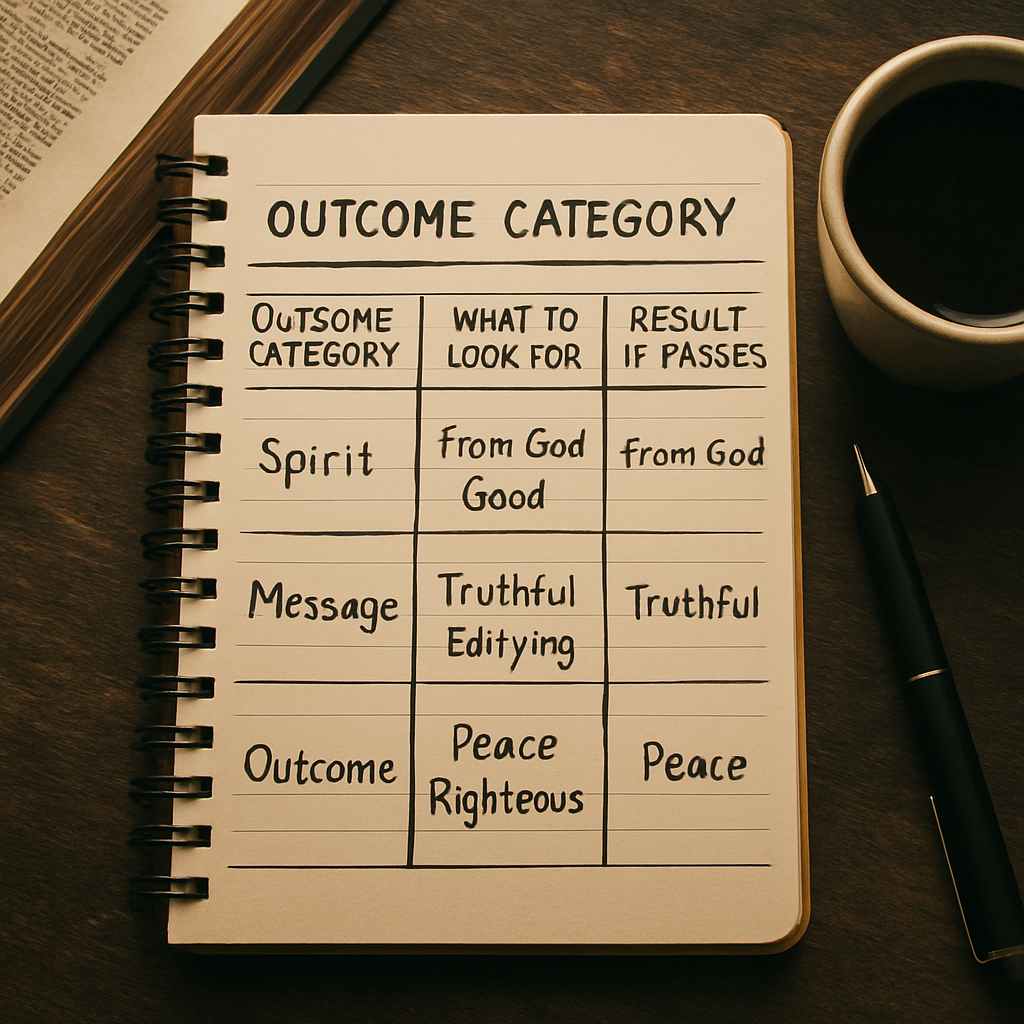
Quick tip: keep a master copy of this table in a folder titled “Spirit Test Master Sheet.” Every time you encounter a new impression, copy the row and fill it in. After a month you’ll have a mini‑report card of your spiritual discernment progress.
So, what should you do next? Pull out your notebook, draw the table, and start populating it with the impressions you’ve already recorded. You’ll be surprised how much clarity a simple grid can bring.
Remember, the goal isn’t to create a bureaucratic checklist that feels like a chore. It’s to give you a visual anchor that makes the abstract process of testing the spirits concrete and actionable. When the rows line up, you’ll know exactly where to place your trust.
Step 6: Seek Wise Counsel and Prayer
At this point you’ve already checked Scripture, run the quick Spirit Scan, and even measured the fruit. The next move feels a lot like getting a second opinion at the doctor’s office – you’re not doubting your own judgment, you’re just adding safety nets.
Why counsel matters
Think about the last time you tried to fix a leaky faucet on your own. You probably ended up with a bigger mess, right? Spiritual “leaks” work the same way. A trusted mentor, pastor, or small‑group can spot a drift you missed because they’re looking from a different angle.
In our experience with individuals seeking spiritual growth, the ones who regularly involve wise counsel report less confusion and more confidence in the decisions they make.
Pick the right people
Not every well‑meaning friend qualifies as “wise counsel.” Look for someone who:
- Shows the fruit of the Spirit consistently (love, patience, humility).
- Is grounded in sound biblical teaching – think someone who can point you to verses, not just feel‑good sayings.
- Listens more than they lecture, so you feel safe sharing doubts.
If you can tick those boxes, you’ve found a good sounding board.
Structure the conversation
Before you sit down, write a one‑sentence summary of the impression you’re testing. Then add two bullet points: the Scripture you think supports it, and the question that still nags you.
During the meeting, start with the summary, share the Scripture, and ask your mentor to “run it through the spirit test” with you. Let them ask the same three questions you used in Step 2: Does it confess Jesus? Does it bear fruit? Does it deepen your relationship?
Take notes. Seeing their answers next to yours on paper makes patterns pop up fast.
Prayer: the ultimate cross‑check
After you’ve talked it through, move into prayer. This isn’t a “recite a prayer and hope for the best” moment; it’s a deliberate, listening prayer. Here’s a quick three‑minute format:
- Thank God for the insight you just received.
- Ask the Holy Spirit to illuminate any hidden bias in your heart.
- Listen in the silence – often the answer is a gentle nudge, not a booming voice.
If you feel a peace that surpasses logic, that’s a strong indicator the impression is from God. If anxiety or uncertainty lingers, keep the conversation going or revisit the earlier steps.
Practical checklist for this step
Grab a fresh page in your notebook and run through:
- Identify a trusted counsel (name, relationship).
- Summarize the impression in one sentence.
- List the Scripture you’ve matched.
- Write down the three spirit‑test questions.
- Record the counsel’s responses.
- Conclude with a three‑minute prayer and note the felt outcome.
When you look back weeks later, you’ll see a clear trail of how each decision was vetted.
Common pitfalls to avoid
Don’t let the “wise counsel” become a popularity contest. Just because someone is charismatic doesn’t mean they’re spiritually mature. Also, avoid the “prayer‑only” shortcut – prayer without counsel can leave you spinning in circles, especially when emotions run high.
Another trap is treating counsel as a one‑time fix. Make it a habit: schedule a monthly “spirit‑check‑in” with the same small group or mentor. Consistency builds trust and sharpens discernment over time.
What to do next?
Pick one person you trust right now, send them a quick text, and set up a 20‑minute chat this week. Bring your notebook, your Spirit Test worksheet, and an open heart.
Then, after the conversation, spend three quiet minutes in prayer, asking God to confirm or correct the direction you’ve just explored. Write down the peace (or lack of it) you experience – that’s the final piece of the puzzle in learning how to test the spirits according to the bible.
Conclusion
We've walked through every step of how to test the spirits according to the bible, from pulling out Scripture to checking the fruit and bringing in wise counsel.
Keep the three quick questions front‑and‑center: does it confess Jesus, does it produce godly fruit, and does it pull you deeper into prayer and relationship with Him?
If you get a yes on two or more, you’ve got a green light. If the answers are mostly no, pause, pray for clarity, and run the impression by a trusted mentor.
Writing each impression in a simple worksheet, running the three‑minute Spirit Scan, and sealing the session with a short prayer creates a trail you can revisit weeks later—and that trail is your proof‑of‑discernment.
So, what should you do next? Grab the first impression that’s nagging you right now, jot it down, run the test, and share the result with someone who lives out the fruit of the Spirit.
When this becomes a regular rhythm, the fog lifts, decisions feel steadier, and you can move forward with confidence, knowing you’re following the true Spirit.
Remember, the journey of discernment isn’t a one‑time event. Keep a journal, revisit past entries, and let each test sharpen your spiritual ear. Over time you’ll see patterns that guide you toward deeper peace and clearer direction.
FAQ
What does the Bible say about testing spirits?
1 John 4:1 is the go‑to verse: “Do not believe every spirit, but test the spirits.” The apostle warns us to compare any impression with Scripture, check whether it acknowledges Jesus, and see if it produces godly fruit. In other words, the Bible gives us three non‑negotiable filters – doctrine, character, and relationship – that any claim must pass before we follow it.
How do I actually do the three‑minute Spirit Scan?
Grab a notebook, set a timer for three minutes, and write down the impression you’re wrestling with. Then ask three quick questions: Does it confess Jesus as Savior? Does it bear the fruit of love, joy, peace, patience, kindness, goodness, faithfulness, or self‑control? Finally, does it draw you deeper into prayer and worship? Mark each answer with ✅ or ❌. If you get two ✅, you’re likely on solid ground.
Why is the fruit of the Spirit such a big deal in the test?
The fruit is the evidence that the Holy Spirit is at work. Galatians 5:22‑23 lists love, joy, peace, patience, kindness, goodness, faithfulness, and self‑control. If a teaching or prophetic word creates anxiety, division, or selfish ambition, the fruit test flags it. Look at the life of the person sharing the idea – are they living out those qualities? That observation often tells you more than any theological argument.
How can I involve wise counsel without feeling judged?
Pick someone who consistently shows the fruit of the Spirit and can point you back to Scripture. Before the meeting, write a one‑sentence summary of the impression, the verse you think supports it, and the question that still nags you. Share that summary first, then invite the mentor to run the three‑question test with you. This keeps the conversation focused on the idea, not on you personally.
What if an impression feels peaceful but doesn’t line up with Scripture?
Peace is a wonderful sign, but it’s not the final arbiter. The Bible warns that false teachers can “appear as an angel of light” (2 Cor 11:14). If you’ve got a calm feeling but can’t find a clear biblical anchor, pause. Write the impression down, search Scripture, and if the match is weak, treat it as a red flag and pray for further clarification.
How often should I run the spirit‑testing process?
Make it a habit, not a one‑off event. Whenever a new impression, idea, or prophetic word pops up, run the quick scan within the same day. Set aside a weekly 30‑minute “spiritual audit” where you review all the notes you’ve taken that week, run each through the three questions, and pray for final confirmation. Consistency builds spiritual muscle memory.
Are there any tools or worksheets that help keep everything organized?
Yes – a simple table works wonders. Create columns for “Impression,” “Scripture Check,” “Christology,” “Fruit,” “Relationship Impact,” and “Result.” Fill in each row as you test new ideas. Over time you’ll see patterns: certain sources may repeatedly fail the fruit test, while others consistently pass. This visual trail makes it easy to revisit past decisions and see how God’s guidance has unfolded.