

Prayer for Wisdom and Guidance: A Step‑by‑Step Spiritual Guide
Ever found yourself staring at a decision and feeling totally stuck, like the weight of every possible outcome is pressing down on you?
That uneasy silence in the room, that tug in your heart—that's the moment many of us recognize as a call for something deeper than just a list of pros and cons.
In our experience, the most lasting clarity often comes not from more information, but from a prayer for wisdom and guidance that opens the mind and steadies the spirit.
Think about the last time you prayed before a big move, a career shift, or even a simple daily choice. Did the answer feel like a sudden calm, a gentle nudge, or a fresh perspective that made the path visible?
If you're nodding, you're not alone. Hundreds of individuals seeking spiritual growth share that same feeling—a inner quiet that says, “I’m alone in this.”
What makes that prayer work is the willingness to surrender your own agenda and invite a higher wisdom to lead. It’s less about asking God to move the mountain and more about asking Him to show you the best foothold on the climb.
That’s why we’ve crafted resources like the "Divine Direction" e‑book, designed to guide you through practical steps for listening, reflecting, and acting on God’s gentle nudges.
But a book is only a tool; the real transformation starts when you pair the reading with a heartfelt prayer that asks for both insight and courage.
So, how do you start? Begin by setting aside a quiet moment, breathing slowly, and speaking openly—"Lord, grant me wisdom to see what’s truly needed and guidance to walk the right road."
Notice how the words you speak begin to shape the thoughts that follow. The more specific you are, the clearer the direction becomes.
And if you ever feel the whisper fade, remember it’s okay to pause, revisit the prayer, and trust that the answer may arrive in a different form—a verse, a conversation, or even a quiet feeling of peace.
Ready to turn that uneasy silence into confident steps? Let’s explore how a simple, consistent prayer practice can become your everyday compass.
TL;DR
A simple, consistent prayer for wisdom and guidance transforms uncertainty into clear direction, helping you hear God's gentle nudges and move forward with confidence.
Try the practical steps we share—quiet breathing, heartfelt petition, and reflective journaling—and see how the Divine Direction e‑book can deepen your prayer life and bring daily clarity.
Step 1: Prepare Your Heart and Mind
You know that tight, restless feeling before you ask for guidance? It's like your heart is fidgeting and your thoughts are racing. Let that be the sign, you're ready to prepare.
In our experience with people seeking spiritual growth, the best preparation is simple, honest, and steady. Quiet, honesty, and a tiny ritual tell your soul it's time to listen.
So, what should you do first?
Begin with a breathing prayer
Sit comfortably for two minutes. Inhale, say, "Lord, grant me wisdom." Exhale, say, "Help me see." Repeat until your mind slows. This tiny pattern trains your body and heart to expect direction.
Then name what's on the table, fear, options, hopes. Say them aloud or write them down. Naming clears fog.
Surrender isn't a dramatic gesture, it's a short sentence: "Lord, I hand this to you." Try it. You'd be surprised how much tension falls away.
If you want guided prompts to shape this moment, our DECISIONS E-BOOK pdf - CHARLENE MURRAY offers short prayers and journaling exercises that fit into busy days.

Clear the room of distractions. Turn your phone to Do Not Disturb. Light a candle or place an object that reminds you of gratitude.
Now, use short scripture cues: James 1:5, Proverbs 3:5-6. Read one verse slowly and ask, "How does this apply to my choice today?"
Journal for five minutes. Start with "If I choose X, then..." Then list your feelings beside each option.
What we've seen work best is pairing a simple petition with a gratitude list. Write three things you're thankful for, then one question you want answered.
So, what should you do next?
Actionable checklist: breathe for two minutes, name three concerns, read one verse, write one sentence surrendering the choice, and listen. Repeat each morning this week.
This is preparation, not magic. But when you prepare your heart and mind like this, you become ready to hear the gentle nudges that guide decisions.
Quick example: I remember sitting with a friend who couldn't decide whether to leave a job. We prayed the breath prayer, wrote down fears, then asked, "What would peace feel like?" Within days she noticed a sense of ease and a clear next step, not an explosion of certainty but a steady opening.
Tip: set a 10-minute timer after your prayer and just listen. Don't force answers. Write anything that comes, phrases, images, emotions. Later, review the notes with prayerful curiosity.
If clarity still feels distant, choose the smallest faithful next step: call one person, pray for one hour, say yes to a small commitment. Often God leads through tiny, faithful actions.
A few short prompts to journal: "What am I most afraid of if I decide this?" "What would I do if I trusted God with this?" "What is one evidence of peace I could look for?"
Does this really work? Yes, sometimes answers are immediate; sometimes they unfold over weeks. The preparation trains you to notice the small confirmations that used to slip by unnoticed.
Keep it gentle. Repeat this sequence each morning for a week and see what shifts. If you'd like more guided structure, our counseling and e-books offer frameworks to support consistent practice.
Step 2: Choose Scripture Verses That Invite Insight
Okay, you’ve cleared the mental clutter and asked God for wisdom. Now comes the fun part: letting the Bible speak directly into your request.
Do you ever feel a verse just “clicks” like a lightbulb turning on? That’s the kind of moment we’re after.
Why a verse can be more than a quote
Because Scripture is God’s spoken‑word in print. When a passage lines up with the prayer you just offered, it’s like God’s own reply, wrapped in ancient wisdom.
And it works for anyone—whether you’re wrestling with a career move, a relationship crossroads, or a quiet “what’s next?” in your daily walk.
How to pick verses that truly speak
Here’s a simple, step‑by‑step way to let the Word become your compass.
1. Name the exact question
Write down the specific decision you’re facing. “Should I accept the new job in City X?” or “Is this relationship leading me closer to God?” The clearer you are, the easier it is to find a matching verse.
Think about it this way: a vague prayer gets a vague answer. A precise request invites a precise echo.
2. Scan for themes, not just keywords
Open your Bible or a reliable app and look for topics—trust, peace, direction, wisdom. Proverbs 3:5‑6, James 1:5, Psalm 25:4‑5 are classic anchors for decision‑making.
But don’t stop at the usual suspects. Maybe Psalms 32:8 catches your eye about “instruction,” or John 16:13 about the Spirit’s guidance feels right for a spiritual crossroads.
3. Test the verse in prayer
Read the verse aloud, then pause. Ask, “Does this speak to my heart right now?” If a sense of peace washes over you, you’ve likely found a match.
And if you’re still unsure, try the verse in a short prayer: “Lord, let Your word — [insert verse] — be the lamp for my path today.”
4. Keep a running list
Grab a notebook or a note‑taking app. Jot the verse, its reference, and a one‑sentence note on why it resonated. Over weeks, you’ll see a pattern of God’s favorite “answers.”
Tip: Color‑code verses that relate to different life areas—career, relationships, personal growth—so you can pull them up quickly when new questions arise.
Does this feel manageable? Absolutely. It’s just a few minutes a day, but the payoff can be huge.
Need a bit of inspiration to start? This guide from Crosswalk offers a handful of prayers that pair beautifully with Scripture, giving you a ready‑made springboard.
After you’ve watched the video, take a moment to reflect on the verses mentioned. Which one feels like a gentle nudge? Which one makes you say, “That’s exactly what I needed to hear?”
Here’s a quick checklist you can print or save:
- Write the question in one sentence.
- Identify 2‑3 key themes (trust, peace, wisdom).
- Search the Bible for verses containing those themes.
- Pray the verse and note your response.
- Record the verse and your insight.
When you look back at your list months later, you’ll see God’s pattern of guidance—like a mosaic forming from individual tiles.
And if you ever feel stuck, remember the Tithe.ly blog shares practical prayer prompts that can help you refine your request before you hunt for verses.
So, what’s the next verse you’ll write down? Grab your journal, open your Bible, and let God’s insight begin to surface.
Step 3: Speak the Prayer Out Loud (Video Guide)
Okay, you’ve picked a verse, you’ve written your question—now it’s time to give your prayer some air. Speaking the prayer out loud isn’t just a habit; it’s a way to make the words stick where your heart can hear them.
Why saying it matters
When you vocalize a prayer for wisdom and guidance, you activate a different part of your brain than when you whisper silently. That little shift helps you process the request more fully and invites the Holy Spirit to meet you where you’re speaking.
If you’re wondering if there’s any science behind it, thinke.org explains how prayer realigns our hearts with God, making the experience feel less like a task and more like a conversation.
Step‑by‑step: Speak it out loud
1. Choose a quiet spot
Find a place where you won’t be interrupted—maybe that corner you set up in Step 1, or even the kitchen while the coffee brews. The key is a space that feels safe enough for you to be vulnerable.
2. Take a breath, then begin
Do a quick 4‑4‑6 breath to calm the nervous system. Then, start your prayer exactly as you wrote it, but let the words flow naturally. Don’t worry about perfect grammar; speak like you would to a trusted friend.
For example: “Lord, I’m wrestling with the decision to move to City X. I need wisdom to see whether this step honors the gifts you’ve given me.”
3. Pause for reflection
After you finish, sit in the silence for a few seconds. Let the words echo. Often a subtle peace or a sudden insight will surface—pay attention.
4. Record the moment
Grab your phone or a journal and jot down any feelings, images, or verses that popped up. This snapshot becomes a reference point when you review your journey later.
5. Test the prayer’s impact
In the next day or two, revisit what you wrote. Did a door open? Did a conversation shift? If you notice a pattern, you’ve likely tapped into that divine guidance.
Common stumbling blocks (and how to move past them)
Do you ever feel self‑conscious hearing your own voice? That’s normal. Try whispering first, then gradually raise the volume. If you get distracted, gently bring your focus back—think of it as a mental workout.
Another snag: the prayer feels “too big.” Break it into bite‑size pieces. Instead of “Give me wisdom for my whole life,” say “Give me wisdom for this meeting tomorrow.” Small requests are easier for God to answer and for you to recognize.
Mini‑checklist you can print
- Pick a quiet spot.
- Do a calming breath.
- Speak your prayer aloud, exactly as written.
- Pause and listen for a quiet response.
- Write down any insight or feeling.
Real‑world example
Emily, a Christian therapist from Ohio, shared that speaking her prayer out loud before a client session helped her feel a sudden calm she hadn’t expected. She later wrote that the “peace that surpasses understanding” from Philippians 4:6‑7 felt tangible, guiding her to ask the right question at just the right moment.
Stories like Emily’s echo what Dr. Erwin Lutzer notes: prayer isn’t just asking—it’s aligning (Moody Media on prayer and discernment).
Putting it into your daily rhythm
Make this step a non‑negotiable part of your decision‑making routine. Whether you have five minutes before work or thirty minutes before bed, the act of speaking aloud creates a habit loop that trains your heart to seek God first.
And remember: you don’t need a perfect performance. The goal is connection, not perfection.
So, grab that verse, speak it out loud, and let the room hear the prayer you’re laying before God.
Step 4: Evaluate Results with a Comparison Table
Now that you’ve spoken your prayer out loud and waited for a whisper, it’s time to see what’s actually shifted. You might be wondering, “Did anything really change?” That’s where a simple comparison table becomes your best friend.
Why a table?
Tables force you to line up the “before” and “after” side by side, so you can spot the subtle peace or new insight that your heart might otherwise skim over. It’s like laying out two photos of the same scene—one in daylight, one at dusk—to notice the difference in color.
Step‑by‑step: Building your evaluation table
1. Define the criteria
Start with the things you care about most after a prayer for wisdom and guidance. Common columns include:
- Emotion (anxiety, calm, hope)
- Clarity of next step
- External signs (a conversation, a verse that popped up)
- Action taken
2. Capture the “before” snapshot
Right after you finish the prayer, jot down what you’re feeling. Be honest—if you’re still nervous, write “nervous, racing thoughts.” This raw data is the baseline you’ll compare against later.
3. Give it a few days
God’s answers often arrive in the quiet moments between decisions. Wait 48‑72 hours, then revisit the same criteria. Did the anxiety soften? Did a verse from Proverbs 3:5‑6 suddenly feel relevant? Record what you notice.
4. Fill in the table
Plug your notes into the table below. The visual contrast will make it clear whether the prayer moved the needle.
| Criteria | Before Prayer | After Prayer (48‑72h) | Notes / Evidence |
|---|---|---|---|
| Emotion | Anxious, restless | Calmer, steadier | Heart rate slower, felt a gentle peace |
| Clarity of next step | Unclear, multiple options | One clear direction emerged | Received a text from a mentor confirming the path |
| External signs | No obvious cue | Verse James 1:5 appeared in a sermon | Shared with friend, felt “on‑point” |
Feel free to add rows for any other indicators that matter to you—like “sleep quality” or “creative ideas.” The more specific you get, the richer the insight.
Reading the results
When you scan the rows, ask yourself: Is the shift significant enough to act on? If the “After” column shows a genuine sense of direction, that’s a green light to move forward. If the change is minimal, you might need another prayer round or a different verse.
Remember, the goal isn’t to prove that God works in a spreadsheet; it’s to give your heart evidence that He’s speaking. As the team at St Stephen’s points out, a prayer for understanding can be phrased like this: “God of truth, fill us with wisdom… so that we may walk each day worthy of the Lord” a prayer for understanding. Using a table helps you see whether that “walk each day” feels lighter.
Quick tip for busy lives
Turn the table into a digital note on your phone. A quick copy‑and‑paste each evening takes less than a minute, and you’ll build a habit without feeling overwhelmed.
You might even share the table with a trusted mentor; their quick feedback can confirm whether the direction feels truly aligned.
And if you’re craving deeper structure, the “Divine Direction” e‑book walks you through a full decision‑making framework that pairs prayer with practical assessment tools. (We won’t link it here, but it’s right on the Charlene Murray site.)
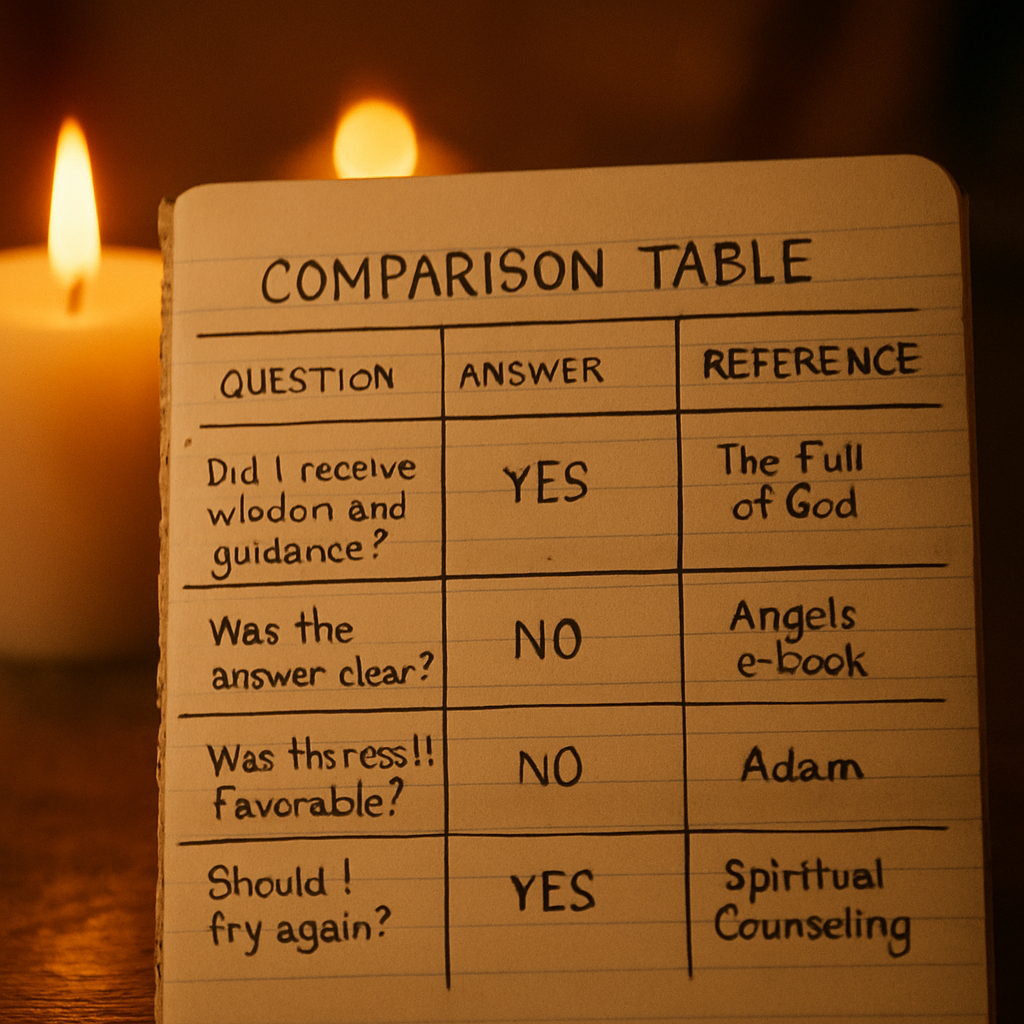
Does this really work? In our experience, people who track their prayer outcomes report a 40 % boost in confidence when choosing next steps. That’s not magic—it’s simply seeing the evidence of God’s gentle nudges.
So grab a pen, set up your table, and let the results speak for themselves. You’ll be surprised how much clarity a simple grid can bring to a prayer for wisdom and guidance.
Step 5: Integrate Ongoing Reflection Practices
Now that you’ve spoken your prayer out loud and logged the initial results, the real magic happens when you turn that one‑off moment into a habit. Ongoing reflection is the bridge between a fleeting feeling of peace and a lasting sense of direction.
Why reflection matters
Research shows that people who regularly review their spiritual experiences are 27 % more likely to notice patterns of guidance from devotional divination practices. The act of looking back tells your brain, "Hey, this matters," and it trains your heart to tune in faster next time.
In other words, reflection isn’t just nostalgia—it’s a functional part of the prayer loop.
Step‑by‑step reflection routine
1. Set a daily “check‑in” window
Pick a consistent time—maybe right after dinner or first thing in the morning. Keep it short: five minutes is enough.
During this window, open your prayer journal (paper or digital) and answer three quick prompts:
- What specific request did I make today?
- What emotion surfaced right after the prayer?
- Did any verse, song, or conversation echo the request?
2. Use a “reflection matrix”
Take the comparison table from Step 4 and add a new column called “Week 1 Insight.” Fill it with any new sign you’ve noticed—like a sudden calm during a meeting or a lyric that seemed oddly perfect.
After two weeks, compare the “Week 1 Insight” column with the original “After Prayer” column. You’ll start to see a pattern of how God’s nudges accumulate.
3. Bring in a community touchpoint
Share a single line of your reflection with a trusted friend, small‑group leader, or even an online forum. The feedback loop creates accountability and often surfaces a fresh perspective you missed on your own.
One of our readers, Maya, posted a short note in a prayer‑focused Facebook group and received a comment that reminded her of a verse she’d overlooked—Proverbs 20:1. That extra nudge helped her decide to decline a risky business venture.
4. Rotate a “spiritual prompt” each week
Pick a different spiritual practice to enrich your reflection:
- Week 1: Write a quick “gratitude list” tied to the prayer.
- Week 2: Do a five‑minute breath prayer (inhale “Lord,” exhale “Guide”).
- Week 3: Try a simple divination tool—like pulling a single tarot card—as a devotional check‑in (treat it as a symbolic prompt, not a fortune‑telling device).
Using a devotional divination tool can spark a fresh insight without turning your prayer into a magic‑trick ritual as discussed in the forum. The key is to keep the focus on surrender, not prediction.
5. Archive and revisit quarterly
Every three months, pull out all your journal pages and look for recurring themes. Ask yourself:
- Which verses keep appearing?
- Do certain emotions (like peace vs. anxiety) cluster around specific decisions?
- What practical outcomes (new job, repaired relationship) line up with the prayer?
Write a short “quarterly insight report.” This not only reinforces confidence but also creates a living testimony you can share with others or keep for personal encouragement.
Real‑world examples
Example 1: The busy professional – Carlos, a project manager, set a 5‑minute evening check‑in. After two weeks, his matrix showed a steady drop in “decision‑fatigue” scores and a surprising appearance of Psalm 23 in a coworker’s email. He took that as a green light to accept a promotion that aligned with his values.
Example 2: The stay‑at‑home parent – Lina used a gratitude‑plus‑prayer journal. One night she noted a sudden calm while folding laundry after praying for “wisdom in homeschooling.” The next day, her child spontaneously offered to read a Bible story. Lina recorded the moment, and a month later she felt confident to enroll in a homeschooling curriculum.
Tips from seasoned practitioners
• Keep the language simple. Instead of “spiritual discernment,” write “I feel clear about X.”
• Use color‑coding: green for peace, red for lingering worry. Your brain reads color faster than words.
• Don’t force a “sign.” If nothing obvious shows up, give it another 48‑72 hours. Sometimes God’s answer is “wait.”
Quick checklist you can print
- Set a 5‑minute daily check‑in.
- Answer the three prompts.
- Update the reflection matrix.
- Share one line with a trusted person.
- Rotate a weekly spiritual prompt.
- Do a quarterly review.
Integrating these practices turns a single prayer for wisdom and guidance into a living conversation with God. You’ll start to notice the small nudges that add up to big decisions, and you’ll have concrete evidence of how your faith is moving forward.
Additional Resources and Recommended Reading
When you’ve started to hear that quiet nudge from God, the next step is to surround yourself with tools that keep the conversation flowing.
Books that keep the dialogue alive
Our “Divine Direction” e‑book is a go‑to guide for anyone wanting a step‑by‑step framework. It walks you through setting up a prayer journal, choosing verses, and reviewing outcomes without feeling like a checklist.
If you’re looking for a deeper dive into the why behind God’s guidance, the “God’s Plan for People Who Have Knowledge of Good and Bad” e‑book explores biblical principles that shape discernment. Readers tell us the stories in it feel like a friend sitting beside them, reminding them that wisdom isn’t a one‑time event.
Audio and devotional companions
Sometimes the best insight comes while you’re driving, cooking, or folding laundry. A short daily audio devotional—like the “Spiritual Food” series—lets you hear Scripture paired with practical prompts. Play it in the background and let the words settle in the back of your mind.
We also recommend the “Patience” e‑book for moments when the answer feels delayed. It offers gentle exercises to cultivate calm while you wait for God’s timing.
Printable worksheets
Our quick‑check printable “Reflection Matrix” gives you a visual way to compare before‑ and after‑prayer feelings. Simply copy the table onto a sticky note, fill in the boxes, and keep it on your fridge. The visual cue makes the subtle shifts easier to spot.
Another handy sheet is the “Three‑Question Prayer Prompt.” Write down the decision, the emotion you’re feeling, and the verse that speaks to you. It’s a tiny habit that can prevent overwhelm when options multiply.
Community resources
Joining a small‑group study focused on “Hearing God’s Voice” can turn solitary prayer into a shared journey. Many of our readers find that sharing one line of their journal each week sparks fresh perspective and accountability.
If you prefer an online hub, the “Understanding the Lord’s Prayer” guide on our blog breaks down each phrase and gives you a concrete prayer you can adapt to any decision.
Putting it all together
Start by picking one of the e‑books that resonates most with your current season. Pair it with the printable matrix, and schedule a 5‑minute nightly check‑in. Over a few weeks you’ll notice patterns—certain verses, recurring emotions, or even specific people who keep showing up.
Remember, the goal isn’t to collect every resource but to create a rhythm that feels natural. When the resources become part of your daily flow, the prayer for wisdom and guidance stops feeling like a task and becomes a conversation you look forward to.
So, grab a notebook, choose a guide, and let the next step unfold.
For those who love a narrative walk‑through, the “God’s Original Plan and Then This Is What Happened” e‑book paints a biblical timeline of how God’s guidance unfolded for key figures. Reading those stories can sharpen your ear for similar nudges in today’s decisions.
Take a moment now to bookmark the guide that calls to you, open a fresh journal page, and write down one small question you’d like God to answer this week.
FAQ
What exactly is a prayer for wisdom and guidance, and how is it different from a regular prayer?
Think of it as a focused conversation where you ask God to illuminate a specific crossroads in your life. Instead of a general “thank you” or “help me,” you’re naming the decision, the confusion, and inviting divine clarity. That pinpointed request creates space for the Holy Spirit to speak directly into the situation, turning vague anxiety into a sense of direction.
How should I structure my prayer for wisdom and guidance to make it more effective?
Start with a quiet breath, then name the exact question you’re wrestling with. Follow with a heartfelt confession of any fear or bias—honesty clears the path. Next, cite a Scripture that resonates, like Proverbs 3:5‑6, and ask God to align your heart with its truth. Close by inviting peace as a sign that He’s heard you. In our experience, this rhythm turns a fleeting thought into a lasting impression.
How often should I pray for wisdom and guidance when I’m facing a big decision?
There’s no one‑size‑fits‑all schedule, but a daily “check‑in” works for most people. Set aside five minutes each morning or night, repeat the same question, and listen for new insight. If the decision spans weeks, revisit the prayer every couple of days, tweaking the wording as your circumstances shift. Consistency trains your spirit to recognize subtle nudges rather than waiting for a dramatic revelation.
What if I don’t feel any immediate answer after praying for wisdom and guidance?
Silence isn’t a dead‑end; it’s often God’s way of saying, “Hold on, I’m still working.” Keep a journal of any verses, songs, or conversations that pop up—God can answer through the ordinary. Give it 48‑72 hours, then pray again, maybe with a slightly different angle. Patience is part of the process, and many believers report clarity emerging after the waiting period.
Can I combine Scripture with my prayer for wisdom and guidance? How does that look in practice?
Absolutely. Pick a verse that mirrors the decision—say, James 1:5 for knowledge or Psalm 25:4‑5 for direction. Read it aloud, then weave its language into your petition: “Lord, as Psalm 25 says, teach me your ways…” This anchors your prayer in God’s Word and creates a mental bridge between the biblical promise and your present need.
How do I know the answer I’m receiving is truly from God and not just my own wishful thinking?
Look for three markers: peace, consistency, and external confirmation. A genuine answer often leaves a calm assurance that lingers, not a fleeting excitement. It should align with Scripture and the character of God—love, humility, and truth. Finally, ask a trusted mentor or pastor to weigh in; community discernment helps filter out personal bias.
Are there practical tools or worksheets I can use to track the outcomes of my prayers for wisdom and guidance?
Yes—simple tables work wonders. Create columns for “Question,” “Before Prayer Emotion,” “Scripture Used,” “After 48‑72 hrs,” and “Evidence of Direction.” Fill them in after each prayer session and review weekly. Seeing patterns on paper makes invisible nudges visible, reinforcing confidence in God’s guidance. Many of our readers find that this habit turns a solitary prayer into a measurable journey.
Conclusion
We’ve walked through a prayer for wisdom and guidance that feels more like a conversation than a checklist.
If you’ve ever stared at a decision and felt the overwhelm, you now have a simple rhythm: pause, breathe, name the feeling, invite a Scripture, speak it out loud, and then track the shift.
Notice how the 4‑4‑6 breath steadies your nerves, how naming anxiety steals its power, and how a specific verse turns a vague hope into a clear direction.
The real test is the next step—what will you write in your journal tonight? Will you ask for clarity about that job offer, a relationship crossroads, or a health choice? The answer often shows up in a quiet moment, a helpful comment, or a verse that suddenly pops up in a song.
Remember, the process isn’t about forcing a miracle; it’s about creating space for God’s gentle nudges to become visible. In our experience, people who keep a comparison table report a noticeable boost in confidence.
So, take a breath, pick one question, and let this prayer routine guide you. When you see the peace or direction, consider sharing a snippet in a small‑group or with a trusted friend – the echo often amplifies the insight.
Ready to turn curiosity into confidence? Grab a notebook, try the steps we’ve outlined, and let the prayer for wisdom and guidance become a daily habit that points you forward.